Sabtu, 13 Juni 2015

MOVIE REVIEW : Confessions Of A Shopaholic


Confessions of a Shopaholic is a 2009 American romantic comedy film based on the Shopaholic series of novels by Sophie Kinsella. Directed by P. J. Hogan, the film stars Isla Fisher as the shopaholic journalist and Hugh Dancy as her boss.


PLOT
Rebecca Bloomwood (Isla Fisher) is a shopping addict who lives with her best friend Suze. She works as a journalist for a gardening magazine but dreams of joining the fashion magazine Alette. On the way to an interview with Alette, she buys a green scarf. Her credit card is declined, so Rebecca goes to a hot dog stand and offers to buy all the hot dogs with a check, if the seller gives her back change in cash, saying the scarf is to be a gift for her sick aunt. The hot dog vendor refuses but a man offers her $20.
When Rebecca arrives at the interview, she's told that the position has been filled. However, the receptionist tells her there is an open position with the magazine Successful Savings, explaining that getting a job at Successful Savings could eventually lead to a position at Alette magazine. Rebecca interviews with Luke Brandon (Hugh Dancy), the editor of Successful Savings and the man who just gave her the $20. She hides her scarf outside his office, but Luke's assistant comes into the office and gives it back to her. Rebecca knows the game is up and leaves.
That evening, drunk, she and Suze write letters to Alette and Successful Savings, but she mails each to the wrong magazine. Luke likes the letter she meant to send to Alette and hires her. Rather than completing a work assignment for a new column, Rebecca goes to a clothing sale. While inspecting a cashmere coat she has just purchased, she realizes it is not 100% cashmere and she has been duped. This gives her an idea for the column, which she writes under the name "The Girl in the Green Scarf" and is an instant success.
Rebecca later returns home to renewed confrontations with her debt collector, so Suze makes her attend Shopaholics Anonymous. After one shopping spree she meets a friendly woman, Miss Korch, only to learn that she is the group leader and forces Rebecca to donate all the clothes she just bought, including a bridesmaid's dress for Suze's wedding and a dress for a TV interview. After the meeting Rebecca can't afford to buy back both and buys back the interview dress. During the interview, the debt collector is in the audience and confronts Rebecca.
Successful Savings terminates Rebecca's column after the public confrontation for bringing discredit on the magazine and believing she is a risk for not paying debts. Suze is angry when she finds out that Rebecca lost the bridesmaid dress, and Rebecca feels like she let everyone down. Rebecca's father (John Goodman) is more sympathetic, making a remark that the United States has not fallen despite its gigantic national debt, and offers to sell his recreational vehicle to help her, but Rebecca says the camper was a result of years of his hard work and saving, and that she will need to tackle her debts on her own. Alette offers Rebecca a position at the magazine, but Rebecca declines. Meanwhile, Luke starts a new company, Brandon Communications.
The members of Shopaholic Anonymous promote Rebecca's clothes sale, which generates a lot of revenue but she is still a bit short of retiring her debts. She finally sells her green scarf when a woman bids on it, making it possible for her to give all the cash to the debt collector, which she pays in pennies--to give it to him in the "most inconvient way possible".
Rebecca attends Suze's wedding after reclaiming her bridesmaid dress, and Suze forgives her. Luke returns the green scarf to Rebecca after revealing that the person who bought it at an auction was acting as his agent. Rebecca becomes romantically involved with Luke and starts working at his new company.


CAST
1. Isla Fisher as Rebecca Bloomwood


2. Hugh Dancy as Luke Brandon


3. Krysten Ritter as Suze (Rebecca’s bestfriend)

Kamis, 19 Februari 2015

Sun Flower

Kingdom: Plantae
Division: Magnoliophyta
Class: Magnoliopsida
Order: Asterales
Family: Asteraceae
Tribe: Heliantheae
Genus: Helianthus
Species: H. annuus


The sunflower (Helianthus annuus) is an annual plant in the family Asteraceae, with a large flower head (capitulum). The stem of the flower can grow up to 3 metres tall, with a flower head that can be 30 cm wide. Other types of sunflowers include the California Royal Sunflower, which has a burgundy (red + purple) flower head.

The flower head is actually an inflorescence made of hundreds or thousands of tiny flowers called florets. The central florets look like the centre of a normal flower, and the outer florets look like yellow petals. All together they make up a "false flower" or pseudanthium. The benefit to the plant is that it is very easily seen by the insects and birds which pollinate it, and it produces thousands of seeds.

The sunflower is the state flower of Kansas. That is why Kansas is sometimes called the Sunflower State. To grow well, sunflowers need full sun. They grow best in fertile, wet, well-drained soil with a lot of mulch. In commercial planting, seeds are planted 45 cm (1.5 ft) apart and 2.5 cm (1 in) deep.

The outer petal-bearing florets are the sterile florets and can be yellow, red, orange, or other colours. The florets inside the circular head are called disc florets, which mature into seeds.

The flower petals within the sunflower's cluster are always in a spiral pattern. Generally, each floret is oriented toward the next by approximately the golden angle, 137.5°, producing a pattern of interconnecting spirals, where the number of left spirals and the number of right spirals are successive Fibonacci numbers. Typically, there are 34 spirals in one direction and 55 in the other; on a very large sunflower there could be 89 in one direction and 144 in the other.

Sunflowers commonly grow to heights between 1.5 and 3.5 m (5–12 ft.). The tallest sunflower confirmed by Guinness World Records is 8.0 m (2009, Germany). In 16th century Europe the record was already 7.3 m (24 ft., Spain).[3] Most cultivars are variants of H. annuus, but four other species (all perennials) are also domesticated. This includes H. tuberosus, the Jerusalem Artichoke, which produces edible tubers.


Sunflower "whole seed" (fruit) are sold as a snack food, after roasting in ovens, with or without salt added. Sunflowers can be processed into a peanut butter alternative, Sunbutter. In Germany, it is mixed together with rye flour to make Sonnenblumenkernbrot (literally: sunflower whole seed bread), which is quite popular in German-speaking Europe. It is also sold as food for birds and can be used directly in cooking and salads. Sunflower oil, extracted from the seeds, is used for cooking, as a carrier oil and to produce margarine and biodiesel, as it is cheaper than olive oil. A range of sunflower varieties exist with differing fatty acid compositions; some 'high oleic' types contain a higher level of healthy monounsaturated fats in their oil than Olive oil.

The cake remaining after the seeds have been processed for oil is used as a livestock feed. Some recently developed cultivars have drooping heads. These cultivars are less attractive to gardeners growing the flowers as ornamental plants, but appeal to farmers, because they reduce bird damage and losses from some plant diseases. Sunflowers also produce latex and are the subject of experiments to improve their suitability as an alternative crop for producing hypoallergenic rubber.

Traditionally, several Native American groups planted sunflowers on the north edges of their gardens as a "fourth sister" to the better known three sisters combination of corn, beans, and squash.[9] Annual species are often planted for their allelopathic properties.[source?] However, for commercial farmers growing commodity crops, the sunflower, like any other unwanted plant, is often considered a weed. Especially in the midwestern USA, wild (perennial) species are often found in corn and soybean fields and can have a negative impact on yields. Sunflowers may also be used to extract toxic ingredients from soil, such as lead, arsenic and uranium. They were used to remove uranium, cesium-137, and strontium-90 from soil after the Chernobyl disaster (see phytoremediation).


SUNFLOWER SEED

The sunflower seed is the fruit of the sunflower (Helianthus annuus). The term "sunflower seed" is actually a misnomer when applied to the seed in its pericarp (hull). Botanically speaking, it is a cypsela. When dehulled, the edible remainder is called the sunflower kernel or heart.

There are three types of commonly used sunflower seeds: linoleic (most common), high oleic, and NuSun. Each variety has its own unique levels of monounsaturated, saturated, and polyunsaturated fats. The information in this article refers mainly to the linoleic variety.

For commercial purposes, sunflower seeds are usually classified by the pattern on their husks. If the husk is solid black, the seeds are called black oil sunflower seeds. The crops may be referred to as oilseed sunflower crops. These seeds are usually pressed to extract their oil. Striped sunflower seeds are primarily used for food; as a result, they may be called confectionery sunflower seeds.

The Sunflower seeds are more commonly eaten as a healthy snack than as part of a meal. They can also be used as garnishes or ingredients in various recipes. The seeds may be sold as in-shell seeds or dehulled kernels. The seeds can also be sprouted and eaten in salads.

When in-shell seeds are processed, they are first dried. Afterwards, they may also be roasted or dusted with salt or flour for preservation of flavor. Dehulling is commonly performed by cracking the hull with one's teeth and spitting it out while keeping the kernel in the mouth and eating it.

Sunflower seeds sold by the bag are either eaten "plain" (salted only) or with a variety of flavorings added by the maker including barbecue, pickle, hot sauce, bacon, ranch, and nacho cheese as well as others.

In-shell sunflower seeds are particularly popular in Mediterranean and Asian countries, including Egypt, Syria, Israel, Turkey, and Malaysia. In Turkey, Syria and Israel they can be bought freshly roasted in shops and markets and are a common stadium food, while in Malaysia they can be bought freshly packed in various roasted flavors. They are also popular in countries worldwide including Russia, Armenia, Poland, Ukraine, Macedonia, Bulgaria, Albania, Romania, Spain, China, Morocco, Iran, Canada and the United States. In the United States, they are commonly eaten by baseball players as an alternative to chewing tobacco.[2]

Dehulled kernels have been mechanically processed to remove the hull. These kernels may be sold raw or roasted. These dehulled kernels are sometimes added to bread and other baked goods for their flavor. There is also sunflower butter, similar to peanut butter, but using sunflower seeds instead of peanuts. Apart from human consumption, sunflower seeds are also used as food for pets and wild birds in boxes and small bags.

Kamis, 29 Januari 2015

Harvard University

Harvard University is a private Ivy League research university in Cambridge, Massachusetts, established in 1636. Its history, influence and wealth have made it one of the most prestigious universities in the world. Established originally by the Massachusetts legislature and soon thereafter named for John Harvard (its first benefactor), Harvard is the United States' oldest institution of higher learning, and the Harvard Corporation (formally, the President and Fellows of Harvard College) is its first chartered corporation. Although never formally affiliated with any denomination, the early College primarily trained Congregation­alist and Unitarian clergy. Its curriculum and student body were gradually secularized during the 18th century, and by the 19th century Harvard had emerged as the central cultural establishment among Boston elites. Following the American Civil War, President Charles W. Eliot's long tenure (1869–1909) transformed the college and affiliated professional schools into a modern research university; Harvard was a founding member of the Association of American Universities in 1900. James Bryant Conant led the university through the Great Depression and World War II and began to reform the curriculum and liberalize admissions after the war. The undergraduate college became coeducational after its 1977 merger with Radcliffe College. The University is organized into eleven separate academic units—ten faculties and the Radcliffe Institute for Advanced Study—with campuses throughout the Boston metropolitan area: its 209-acre (85 ha) main campus is centered on Harvard Yard in Cambridge, approximately 3 miles (5 km) northwest of Boston; the business school and athletics facilities, including Harvard Stadium, are located across the Charles River in the Allston neighborhood of Boston and the medical, dental, and public health schools are in the Longwood Medical Area. Harvard has the largest financial endowment of any academic institution in the world, standing at $32.3 billion as of June 2013. Harvard is a large, highly residential research university. The nominal cost of attendance is high, but the University's large endowment allows it to offer generous financial aid packages. It operates several arts, cultural, and scientific museums, alongside the Harvard University Library which is the world's largest academic and private library system, comprising 79 individual libraries with over 18 million volumes. It has many eminent alumni. Eight U.S. Presidents and several foreign heads of state have been graduates. It is also the alma mater of 62 living billionairs and 335 Rhodes Scholars, both the most in the country. To date, some 150 Nobel laureates have been affiliated as students, faculty, or staff.

Rabu, 21 Januari 2015

Last Holiday

Last holiday I went to some places in Bandung and went to Jakarta with my family. I went to some mall with my friends, hang out, went to some cafe, and watched movie in the cinema. I went to Jakarta in the morning, at 9 a.m. from Bandung. Before arrives at Jakarta, we got a brunch at Sate Maranggi Cibungur Purwakarta. And then I arrived there at 11 a.m. I went to Grand Indonesia Shopping Town with my family. Then we went to the ice cream cafe that didn't open in Bandung, that is Ron's Laboratory. It was very nice. After that, we looked around the mall and did some shopping. We spent the day just at the mall. And then we ate at the foodcourt in the mall. After we finished shopping, we came back to Bandung in the evening, at 6 p.m. The traffic jam was very bad so we couldn't came back to Bandung as fast as we could. So we arrived at Bandung at 9.30 p.m. On the New Year Eve, I and my family just stayed at home because we were too lazy to go because it must be a bad traffic jam. So we just spent the night at the house. I went to some mall with my friends. I went to PVJ, and then watched Night At The Museum 3 (it was awesome!). And then I went to some cafe like Beehive, Pots & Pans, Sushigroove, etc. The holiday was awesome, even though I didn't go to other countries but I think it always be a good time when we shared it with a good people.

Rabu, 19 November 2014

My Experience

On Saturday, 7th of November 2014, I and my friends spent our Saturday night together. First, the boys in my class played football (Liga BM) in Lapangan Bali. My class played versus XI Science 3. My class finished playing in Liga BM at 3 p.m. I watched they played with my friends (the girls). Although my class lose the game, but it’s okay. After the boys finished playing in Lapangan Bali, we came back to SMA 3 to prayed Ashar. After we finished pray Ashar, we decided to watch the movie. But we must wait our friend that still in his house. And finally he came. After he came, we went to the cinema to watch the new horror movie, that’s Ouija. We went to the cinema with motocycle. There were about 5 motocycles. In our way to the cinema, it was raining! We didn’t know how should we do, because the rain was getting heavy. Finally, we decided to stop in the restaurant and waiting for the rain to stop. It was very fun. When we waited the rain stopped, it didn’t stop! So, we decided to continue our way to the cinema with wearing the umbrella in the motocycle. It was so embarrassed but we didn’t care about it anymore because it must be very long time if we waited the rain stop. On the way, we laughed because people in the street took a look at us! Some minutes later, we arrived at the cinema. We arrived at about 5 p.m., and then we ordered the ticket. But, the theatre that showed the movie at that time was full. So we decided to watch the movie at 6.45 p.m. While we waited for the movie, we ate first. We ate at Wendy’s. In Wendy’s, we played Truth or Dare game. But we can only choose “dare”. First, we spin the pen, and then I got the first turn. And then my friends asked me to took a selfie with the waiter of Wendys. It was so embarrassed. But I must followed the request. And then in my friend’s turn, the one must do the “cilukba” in front of cashier, the one must dance in front of cashier, and the one must dance with the singer in the stage. It was very fun. After we finished eating, we went to the teathre and watched the movie. It was very scary movie. I really enjoyed watch the movie because the movie was good.

Sabtu, 25 Oktober 2014

Bakti Desa

Bakti Desa is an annual internal SMAN 3 Bandung's program. This is the program that we go to the village for 3 days and we worked with the people at that village. The purpose of Bakti Desa is we can feel how to see the world through their eyes. Bakti Desa held on Thursday, 23rd of October 2014, until Saturday, 25th of October 2014. At first day (Thursday), first we gathered at SMAN 3 Bandung at 6 a.m. We went there by public transportation (angkot). We went to the location at 8 a.m because we had to prepare our packing first. We arrived at Desa Resmi Tingal at 10 a.m. First, we gathered at Balai Desa, and then we sit to did an Opening of Bakti Desa. In the opening, our headmaster, Mr. Encang, spoke and gave us a speech about this program. After that, the Mayor of the village was also gave us a speech. After that, we lunch at Balai Desa with the prasmanan menu. After we finished eating, we went to our house in the village. We were divided in a group, which one group consist by 4 or 3 people. I'm on the Group 1 Putri, the member is female students in my class from absent 1 until absent 4. My group's house was at RW 08. The parents in my house was Bapak Amang Enan. He worked as the helper in the mosque (like sweeping the mosque, etc.), and his wife worked as the gardener. This is the picture of Bapak Amang's house.
We walked to the hill, and then we can saw the view of the mountain. It was very very cold. But it was very amazing and I looove it.
On the first day, we pray Maghrib at the mosque. We also followed the "Pengajian", it was very nice. We prayed Isya at the mosque too. After we finished pray, we came back to our house. At 8 p.m., my class gathered at RW 08, we did the bonfire. It was very wonderful. We talked to each other, and that moment made me very happy. The second day, i with my friends went to the river. The river is soooooo far from our house, so we must walked through the steep hill. It was quite difficult.
At the night, there was a little event at Balai Desa. Because of the Islam new Year, the people at the village did the Pawai Obor. It was very cool. After pawai obor, there was some bonfire in Balai Desa. The third day, in the morning, we gathered in the mosque to do the counselling (education) about health. The speaker was from our class, and Kang Dito from Faculty of Medicine Maranatha University. The audience were the people that lived in Desa Resmi Tingal. After we did the counselling, we prepared our bags and put it in Balai Desa. After that, we waited for the transportation. We came back to Bandung at 11.30 a.m. We arrived at SMAN 3 Bandung on 2.30 p.m. I was tired, and also my bag was really heavy, but Bakti Desa was very awesome! So many lessons that I can took from these 3 days. This was really worth.

Matswapati 2014

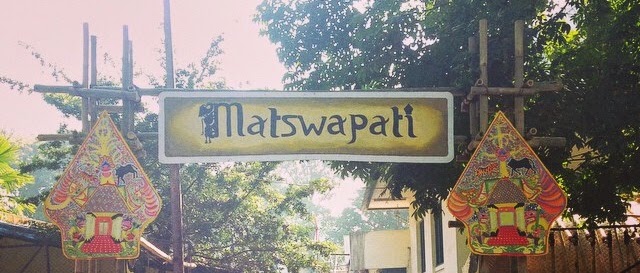
MATSWAPATI is a festival held by SMAN 3 Bandung on Saturday, 27th of September 2014 at Lapangan Bali. This is the first festival by SMAN 3 Bandung after vacuum for 7 years. It's been 7 years since 3 Senior High's last event. In Matswapati, we can see so many culture from our province, West Java. The culinary at Matswapati are from Sundanese. There were so many guest stars, like Glenn Fredly, Barsena, Saung Angklung Udjo, and many more; and also from the students of SMAN 3 Bandung, like Tiloe's Theatre, Musik Klasik 3, Vocal Group, and many more. It was very amazing.
I'm so proud to be a student of SMAN 3 Bandung that can present an awesome festival like Matswapati. I was worked as the Decoration Comittee. The price of the ticket is Rp25.000.
I was very happy and enjoyed the festival, especially when Glenn Fredly sang on the stage. It was awesome!!! We sang together in every song.
This event is also supported by the Mayor of Bandung, Mr. Ridwan Kamil. He also came on the opening of MATSWAPATI.